Many people repeat the old claim that long strokes make high torque. “It just stands to reason,” they say. “Making the stroke longer means the pressure on the piston is acting on a longer lever, so it’s gotta be true.”
If increasing the stroke is the only change we make, the claim is true as stated, but the longer stroke has also increased engine displacement. But if we are comparing two engines of the same displacement, and what we are changing is the ratio of bore to stroke, we must look at an example. Imagine we plan to build a V-twin of 74 cubic inches displacement, and are trying to decide what bore and stroke to give it.
Some definitions: An engine whose bore and stroke are equal to each other is called “square.” An engine whose bore is larger than its stroke is called “oversquare,” and the opposite is called “undersquare.”
Just for example, let’s build one engine with a 4-inch bore. Doing the arithmetic, we find that stroke will be 2.94 inches for a 74-cube displacement. We give the other engine a longer stroke by making its bore smaller, say 3 inches. Doing the arithmetic, we find that its stroke will be 5.234 inches—much longer than the previous example. Dividing 5.234 by 2.94, we find their ratio to be 1.78.
Now let’s compare what the change has done to the piston area, which is the area against which combustion pressure pushes during the power stroke. For the short-stroke 74, piston area is 12.57 square inches, while for the long-stroke 74, it is 7.069 square inches. Dividing 7.069 into 12.57 we find their ratio to be 1.78.
What this tells us is that as we increase an engine’s stroke while keeping its displacement constant (in this case, 74 cubes), its piston area decreases by the same amount. This tells us that for an engine of constant displacement, as we increase stroke, piston area decreases by the same percentage. Yes, the lever-arm by which the piston turns the crank is longer, but the piston area against which combustion pressure acts is smaller by the same proportion. Conclusion: in an engine of constant displacement, given no change in combustion pressure, making stroke longer does not increase torque.
Now To Look More Closely
OK, now let’s see if there’s some other good reason why so many people associate long strokes with high torque. Here’s an idea. An engine’s valve sizes are limited by its bore size, and there is a limit to how fast the atmosphere can push air through a valve of a given size. We can see this in the many 74-cubic-inch V-twins Harley-Davidson has built over the years. With the short timings of their stock cams, these engines run out of breath as they approach 5000 rpm. This is because flow through the smallish intake valves is moving so fast at 5000 revs that it is being choked by air drag and early Mach effects. Peak torque occurs at maximum flow happening at lower revs, say 3000-3500. This is intentional, because the Motor Company knows that its heavy motorcycles need high torque at moderate revs to get moving without a lot of theatrics like revving and clutch-slipping.
This is a design choice: to place the rpm of maximum valve flow at lower revs, enabling the motorcycle to accelerate smoothly from rest, and to have solid torque for on-ramps and passing at 3000-3500 rpm.
But the usual reason for a larger bore is to make room for bigger valves.
Now look at our other 74, the one with a much bigger 4-inch bore. We could put the smaller valves of the 3-inch bore engine into the 4-inch bore and get similar performance: peak intake valve flow at 3000-3500, with intake velocity just above idle fast enough to do a decent job of cylinder-filling as we ease away from the stop-light.
Bigger Bores Are Usually Chosen To Make Room For Bigger Valves
But the usual reason for a larger bore is to make room for bigger valves. Their purpose is to move the point of best intake flow and maximum torque up the rpm scale to boost high-rpm acceleration and top speed. Let’s say its peak torque and best intake valve flow occur up at 7000 rpm, with peak power (which occurs where engine breathing is fading fast enough that there’s no power gain in higher revs) up at 8500. We call this a sports engine, so you can bet the engineers have given it longer cam timings than those in our 3-inch bore engine. They are closing the intakes a good many degrees after bottom center. Why? Having accelerated the intake flow up to hundreds of feet per second, it would be a shame to waste all that intake energy by closing the intake at Bottom Dead Center. So we leave it open long enough after BDC to let that high intake velocity keep on filling the cylinder even as the piston is rising on compression, trying to stop intake flow or even push some charge back out.
Now let’s check what happens down at 3000. Intake velocity down at 3000 is only 43% of what it is at peak torque. At that lower velocity, it is easily stopped by the rising piston, so some charge is back-pumped out of the cylinder. The result is poor cylinder-filling and weak torque at 3000, but very strong torque up at 7000. The result is a classic sportbike torque curve, that goes nothing, nothing, nothing, WHAM! This is great for high-speed acceleration (no 5000-rpm wheeze-out) and high top speed, but it’s dullsville at 3000.
Some people prefer the 3-inch bore engine’s feeling of torque everywhere. Where it’s able to pull smartly away from rest and accelerate strongly at any rpm up to the onset of wheeze-out approaching 5000. This is a twist-and-go engine. They say it feels “torquey.”
Some people like the hard hit of high-rpm torque engine up at 6500-8500, even though down at 3000 or so they’d have to shift down a gear or two to get the engine spinning in its higher torque range (around 7000) to get strong acceleration. Its torque is strong, but only in the range of 6500-8500. It feels “peaky.”
What if you ride a big touring rig but discover what I’ve discovered: in this crazy world; rush-hour can jam even Interstate highways for minutes at a time, then be madly racing, almost bumper-to-bumper at 90 mph seconds later. The 4500-5000-rpm wheeze-out can’t do this so even conservative older riders want more. But they’re unwilling to give up that torquey feeling to get it.
Ways To Have Torque Everywhere
Engineering is now able to bring these extremes closer together.
The first step is to move from two valves per cylinder to four. Because four valves generate flow area faster than two valves as they lift, they don’t need late intake closing to move the intake wheeze-out point upward from the traditional 4500-5000. But the resulting short intake timing doesn’t cause wheeze because with two intake valves there is more valve area. BMW four-valved their boxer twins back in 1993, Honda’s Gold Wing got it in 2018, and Harley’s Milwaukee Eight came in 2017. This allows strong higher-rpm torque for onramp and passing, but without losing bottom torque needed to heave a big tour rig into motion with dignity. I really admire Gold Wing’s bottom torque: 80% of peak torque is available from 800 rpm. That’s right, eight hundred.
Like Honda did with VTEC, BMW took a further step in 2019 with its Shift-Cam. Each cam has two different sets of profiles: one that gives powerful bottom torque and another that provides the stronger highway performance riders now seek. The cams are quickly shifted sideways to transition from one profile to the other.
The Effect of A Larger Bore
Making the bore larger affects flame speed. The late noted tuner “Mississippi Round Man” Larry Worrell described experiments at American Honda with different stroke lengths. Ignition timing for best torque (MBT) was shortest in the smallest-bore cylinder with the thickest (vertically) combustion chamber, while the shortest stroke and thinnest combustion chamber required the earliest spark timing for best torque.
During the evolution of F1 engines, the bore/stroke ratio progressed from around 1.0, to a really strange extreme around 2004 in which bore/stroke equaled 2.5. Super oversquare!
In the small-bore, longer-stroke condition (undersquare), there was plenty of room in the combustion chamber for the rapid movement of the intake stream to continue through compression. We might call this chamber a “hockey-puck” design—plenty of room for the fresh charge to swirl or tumble during compression, turning into vigorous turbulence around TDC that speeds flame propagation. Also, in small-bore engines, the flame travel from a central spark plug to cylinder wall is shorter.
But in the extremely oversquare (bore/stroke = 2.25) F1 V10 engines, much earlier ignition timing was necessary to make best torque. In such a vertically thin, wide chamber (call it a “thin disc,” like a silver dollar) fresh charge motion is quickly damped out by contact with all that surface area. Result? Slower combustion. They had to fire the spark at around 60 degrees BTDC to achieve best torque.
Why such large bores and short strokes? Claudio Domenicali, CEO of Ducati, explained that what was gained by the higher rpm permitted by huge valves and short stroke was greater than what was lost in such slow combustion (losing heat to head and piston crown for such a long time).
The Tendency To Increase the Bore
During the long development of England’s classic single-cylinder race bikes, bore was, from time-to-time, increased by small amounts. As they developed an engine, and its rpm was pushed up to perform the power-producing cycle more frequently, it eventually reached the “wheeze-out” point for intake flow, preventing any further power gain. To continue development, they had to increase bore to make room for slightly larger valves that could supply the airflow needed at higher revs.
Another effect of enlarging the bore and shortening the stroke is that at any given rpm, piston acceleration was reduced in proportion to the change in stroke. Why worry? Because a major form of piston failure remains to be fatigue cracking around the wrist-pin boss as a result of piston acceleration and deceleration, as it stops and reverses direction every 180 degrees. This is because peak piston acceleration is proportional to the square of engine rpm.
This peak piston acceleration in the classic Manx Norton 500 Single was about 4000 times the acceleration of gravity (4000 g). In the hottest of the high-revving 600 Supersport production engines of the early 2000s it was as high as 7000G. And in the present final year of the 1000cc 18,000-rpm MotoGP formula, it is pushing 11,000 g.
The Curse of Compromise
In the early days of 750 Superbike (1983) a builder often had to choose between acceleration and top speed: you couldn’t have both. If you chose acceleration, you naturally raised compression by as much as possible (the rule-of-thumb is, peak combustion pressure in a well-developed engine is roughly 100 times the compression ratio).
But if you took that high compression engine to Daytona it would do well in the infield but be a flop on the banking. High compression reduces the volume above the piston at TDC, causing fresh charge motion to die away faster, because its motion is quickly slowed by lack of smoothness of combustion chamber surfaces. As a result, earlier timing was required (stock on Yamaha’s FZR750 was 45 degrees) and this brought increased heat loss (longer exposure to hot combustion gas).
Can there be a compromise?
Jonathan Rea won six consecutive World Superbike titles from 2015-2020 on the Kawasaki ZX-10-based engine which had the longest stroke in the class at 55mm. Clearly, that compromise worked for a long time.
That was then. Today that class is being won by Ducati (48.4mm stroke) and BMW (49.7mm).
The theoretical advantages of bigger bore and shorter stroke do not guarantee success. In 1991 Kawasaki’s Superbike-eligible 750-4 was switched from a 51.5 mm stroke to a 47.3 mm stroke, with a bigger bore. “Mr. Superbike,” Rob Muzzy, told me it took him two years to match the power of the previous engine.
In 1988 Suzuki shortened the stroke of its 750 from 48.7 down to 44.7mm, with a matching increase in bore. Their problems with matching the performance of the previous engine were so great that they switched back to the 1987 bore and stroke in 1990.
Ducati’s Scientific Method
During a visit to Ducati I presented these examples to Claudio Domenicali, and asked him how Ducati, who were constantly changing the bores and strokes of their successful big Superbike V-Twins, yet were able to avoid the setbacks encountered by Kawasaki and Suzuki.
He replied that while he had no knowledge of what went on at other companies, he did know Ducati’s methodology. They optimized in-cylinder tumble motion by 1) varying intake port downdraft angle and 2) adjusting the intake velocity by small changes in intake port I.D. To measure if they were “getting warmer or cooler” they employed an in-cylinder anemometer-like device to measure tumble speed. They knew the best tumble rpm from all their testing.
Tumble motion results when incoming flow from the intake valves hits the far cylinder wall, flows down to the piston crown, across it, and back up the near cylinder wall in a continuous loop. In the two-valve days, the intake flow entered the cylinder more on a tangent, making intake flow swirl around the cylinder axis.
Likely today this work would be done by digital simulation plus physical validation.
Piston Shaking Force
Making the stroke longer with no other changes increases piston shaking force in direct proportion (given equal piston weights). Increasing rpm increases piston shaking force in proportion to rpm, squared.
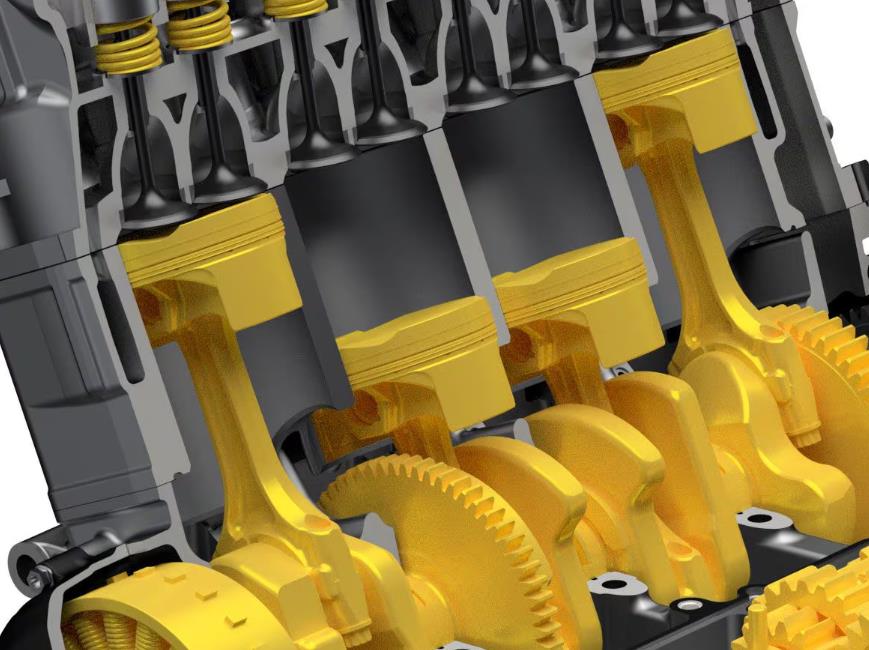
Shaking force is also directly proportional to piston weight. The coming of piston cooling oil jets has made it possible to reduce piston weight without piston overheating. Before oil jets, piston crowns had to be quite thick to act as “heat highways,” conducting heat flowing into the piston crown outward to the cooler cylinder wall. Look at the pistons of late-model Harley Big Twins and see the changes oil-jet cooling has enabled.
In olden times, piston skirts had to be long, with plenty of cylinder-wall contact area, to conduct away piston heat. But today, not only are piston crowns thinner but skirts can be much shorter (oil jets are now carrying away the heat.) The result looks exactly like modern racing pistons: all that’s left is a disc to carry the piston rings, braced underneath by two pairs of reinforcing webs at 90 degrees, and with very short skirts on thrust and non-thrust piston faces. One pair of reinforcing webs is pierced by holes for the piston pin. That’s it.
The EPA Influence
You’ve probably noticed that the bore/stroke ratio of production car engines has been steadily shifting away from oversquare, toward undersquare (smaller bores and longer strokes). This is driven by regulatory pressure to reduce fuel consumption and carbon emissions. As the bore becomes smaller and stroke becomes longer, total area exposed to hot combustion gas decreases, and as seen above, combustion speed increases. This (given good engineering) brings reduced heat loss from combustion gas to the engine’s cooling system.
No one can know what’s coming next. A number of years ago a Ford engineer told me that 40% of their R&D budget was going for what he called “contingency engineering,” preparing in advance for everything government regulators might be planning.