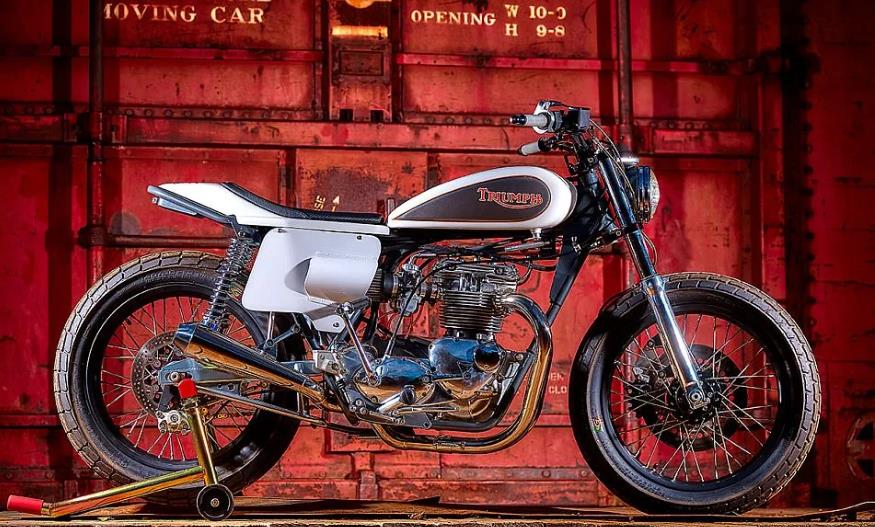
The Triumph parallel twin is a silhouette that has defined the dirt oval for over half a century. Long before the custom scene turned every street bike into a pseudo-scrambler, the Triumph flat tracker was a specialized tool. In the 1960s and 70s, legendary frames from Trackmaster and Redline housed the 650cc and 750cc motors, creating machines that were light, narrow, and very fast.
Today, the tracker aesthetic has migrated from the dirt to the pavement. A true street tracker takes the stance of a racer, wide bars, 19-inch wheels, and a slender fuel tank, and adds just enough legality to survive the urban jungle. The Triumph platform remains the gold standard for this look, offering a mechanical honesty that fewer and fewer modern “supercomputers” can claim.
J. Webster Designs: The “Unscrambled” 900
Scramblers are built for the trend, but Justin Webster’s 2014 Triumph Scrambler was built for the throat. Justin, a self-taught fabricator from Gainesville, Florida, saw a monster hiding under the factory’s ‘sheep’s clothing’ and set about a radical redesign. He stripped the frame to its backbone, redesigned the down tubes to make the motor a stressed member, and converted the rear end to a monoshock setup using a Gears Racing unit.
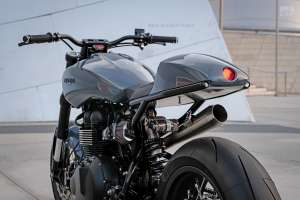
The suspension is a high-performance cocktail, featuring 50mm Marzocchi forks from a Ducati Hypermotard paired with custom-machined triples and a GPR V4 steering stabilizer. To give the 865cc motor the bite to match its new bark, Justin sent it to Bonneville Performance for a 995cc big-bore upgrade. With Nikasil-plated cylinders and a balanced crankshaft, the power and torque have effectively doubled over the stock figures.
Visually, the bike bridges the gap between tracker and modern concept. The fuel tank was lifted from an Indian Scout and modified to fit the Triumph fuel pump, while the tail section was hand-laid in carbon fiber. Finished in a custom Lamborghini-inspired grey with a touch of green pearl, it is a 100-horsepower pavement-eater that begs to be ridden hard.
Mule Motorcycles: The Panther T140
Richard Pollock, better known as ‘Mule,’ is widely considered the undisputed king of street trackers. This silver masterpiece is built around a rare 1970s Panther frame and swingarm from British Columbia, housing a hot-rodded 1973 Triumph T140 engine. The 750cc parallel twin was built by the experts at Branch-O’Keefe, featuring 34mm Mikuni carbs and a custom exhaust system by Mark McDade.
Mule’s hallmark is his ability to blend performance parts with a classic silhouette. He fitted 43mm Showa adjustable forks from a Buell M2 Cyclone and paired them with 19-inch Sun rims built by Buchanan’s. The braking is surgical, utilizing a front hub from a Yamaha XS650 and Brembo calipers. Despite the vintage look, the bike features modern conveniences such as an electronic ignition for smooth delivery.
The bodywork is lean and functional: a Storz tank originally meant for a Harley-Davidson Sportster and a modified Ron Wood Rotax seat. The side panels protect cone filters, while the stainless bars are Mule’s own proprietary design. It took three years to complete, but in the world of high-performance trackers, Pollock’s work remains the formula for perfection.
MFix Workshop: The “SR900” Reggae Tracker
Custom motorcycles are personal statements, and this Triumph Street Twin from Vietnam’s MFix Workshop is a loud one. The client requested a reggae-themed livery combined with a top-tier performance spec. MFix responded by gutting the OEM wiring for a Bluetooth-enabled Motogadget mo.unit and upgrading the engine with a TEC camshaft and a Power Commander 6 ECU.
The chassis received a massive overhaul, including adjustable Öhlins FG 621 forks and an aluminum swingarm from a Triumph Thruxton R. K-Tech Razor shocks handle the rear, while Kineo wheels (19F/17R) wrapped in Metzeler Tourance rubber provide the tracker stance. The braking is handled by Brembo Serie Oro calipers, ensuring the “irie” vibes are backed by serious stopping power.
The bodywork features a hand-made composite flat track tail and a custom radiator guard. To satisfy the owner’s love for the Yamaha SR400, MFix added “SR900” badges and an Acerbis heat shield on the Zard exhaust. It is a chaotic, retina-searing mix of cultures and components that manages to be one of the most well-specced street bikes in Southeast Asia.
ASH Motorcycles: The Thruxton Street Tracker
ASH Motorcycles made their debut with this Triumph Thruxton 900, and they hit a home run. Based in Dorset, England, the team, Tim Abbey, Jez Speed, and Chris Hill, set out to transform the “done-to-death” Thruxton into a street tracker with an aggressive stance.
The 19-inch Excel rims are laced to Talon hubs and wrapped in Maxxis flat track rubber, while the rear suspension is handled by Öhlins. The fuel tank is a work of art, inspired by classic Trackmaster units and hand-shaped over a wooden buck. To accommodate the new tank, the team fitted an external fuel pump and a Twin Power air box eliminator kit.
The detail work is exquisite: a bespoke tail section, a TIG-welded stainless exhaust, and a dark grey Cerakote finish on the engine cases. The paint is a timeless mix of bare aluminum and graphite with candy red pinstriping. For a debut build, ASH Motorcycles set a standard that most veteran shops would struggle to match.
Triumph Limoges: The 1200 Speed Twin Tracker
When Triumph France launched a dealer build-off, Triumph Limoges responded with a 1,200cc Speed Twin flat tracker that set a formidable bar. Shop boss Nicolas Ginouves and technician Denis drew inspiration from a vintage TR6 racer, aiming to build a bike pretty enough to win a show yet rowdy enough for hooligan racing.
The most ingenious part of the build is the fuel system. To swap the tank for a vintage-style cover, Denis moved the fuel and pump into a custom aluminum reservoir hidden under the seat. The original speedo was then remounted inside the fake tank. The bike rolls on 19-inch Excel rims with Dunlop DT3 tires, a setup that required some wizardry to fit into the stock swingarm.
The control area is pure race-spec: ProTaper bars, a tethered cutout, and a complete absence of front brakes. A two-into-one Zard exhaust provides a thunderous soundtrack. Finished in a simple yellow coat with red Triumph logos, it is a modern homage to the TR6 that is already destined for the French Flat Track championship.
Hookie Co.: The “Snow Tiger”
Nico Mueller, founder of the Dresden-based shop Hookie Co., built this 1967 T100R Tiger as his personal track weapon. He found the bike on eBay, discovering it had been a brakeless short-track racer from 1970 to 1990. Nico rebuilt the frame with new engine mounts, steepened the rake for better geometry, and fitted a set of shortened BSA forks.
The 500cc motor was entrusted to Carsten at South Division, who increased the compression and installed a dual-coil electronic ignition. Additionally, it now runs on Wassell carbs and oversized K&N filters. For the wheels, Nico performed a brilliant Hookie Co. move: modifying a pair of classic BMW ‘snowflake’ wheels to fit the Triumph.
The bodywork is a mix of custom and original: an aluminum fuel cell hidden under a fiberglass cover from Survivor Customs, and an original Bates seat. The rear brake setup is a Frankenstein of a Honda disc and a Yamaha scooter caliper. Dubbed the ‘Snow Tiger,’ it is a sharp, functional racer that perfectly encapsulates Hookie Co.’s modern-meets-vintage aesthetic.
Redmax Speed Shop: “The Knobbler”
When you want a tracker in the UK that is hard as nails, you go to Steve Hillary at Redmax Speed Shop. ‘The Knobbler’ was built for a client who wanted a Hinckley Bonneville tracker that could handle both the motorway and Hampshire trails. Steve used a lightweight Redmax tracker frame that weighs just 16kg, including the swingarm.
The 865cc engine is juiced by 38mm Mikuni carbs and a stainless 2-into-2 high pipe system. The front end features fully adjustable Yamaha R6 forks in Fastec yokes, while the wheels are black-powder-coated alloy rims fitted with Motoz Tractionator Adventure tires. Brembo brakes from a Ducati Monster provide the stopping power.
The bike’s defining feature is the dual-halogen Baja headlamp setup and the Ferrari metallic red paint job. An RFID unit under the seat allows for keyless starting, while a Motogadget m.unit manages the electronics. As Steve Hillary says, the goal was to be ‘the knobbler, not the knobbled’—a bike so fast and light that it demands respect.
Double Six: The Gene Hartline Trackmaster
While many trackers never see the dirt, Gareth Howes’ 1970 Trackmaster is a bona fide vintage racer that gets regular thrashings. Sourced from an auction in the US, the bike was originally owned by Gene Hartline, an ex-Trackmaster employee and Hollywood stuntman. Gareth restored the machine with the help of Rick Bearcroft, keeping the patina and history intact.
The heart of the beast is a 750 Triumph twin that was never stamped, indicating it was built solely for racing in 1970. The team re-honed the cylinders and rebuilt the twin Mikuni carbs and ARD magneto. The chassis is a period-perfect setup of Ceriani GP forks and Akront rims, though Gareth added a Brembo rear brake for modern safety on the track.
The aesthetics are strictly 1970s: a Cycle Works fiberglass tank finished in stunning ‘Paint By Matt’ livery and a Bates seat. There is no front brake, no headlight, and no speedometer. Raced by the stylish Dimitri Coste, the bike recently bagged a third-place finish, proving that these vintage icons are best enjoyed at full noise on a dirt oval.