If there’s one thing years of riding and wrenching have taught me, it’s this: most motorcycle problems don’t start as catastrophic failures—they begin as small, almost invisible issues that riders ignore until they’re stranded on the side of the road. This article isn’t a generic overview. Instead, I’m going to walk you through one of the most common, frustrating, and misunderstood real-world problems riders face: a motorcycle that won’t start reliably, and how to diagnose and fix it step by step like someone who’s actually spent nights in a garage chasing ghosts through wiring harnesses.
The scenario is familiar. You turn the key, hit the starter, and instead of that satisfying ignition, you get a weak crank, a click, or nothing at all. Maybe it started fine yesterday. Maybe it’s been getting worse for weeks. Either way, this is where most riders either panic or start randomly replacing parts. That’s the fastest way to waste money. The smarter approach is structured diagnosis.
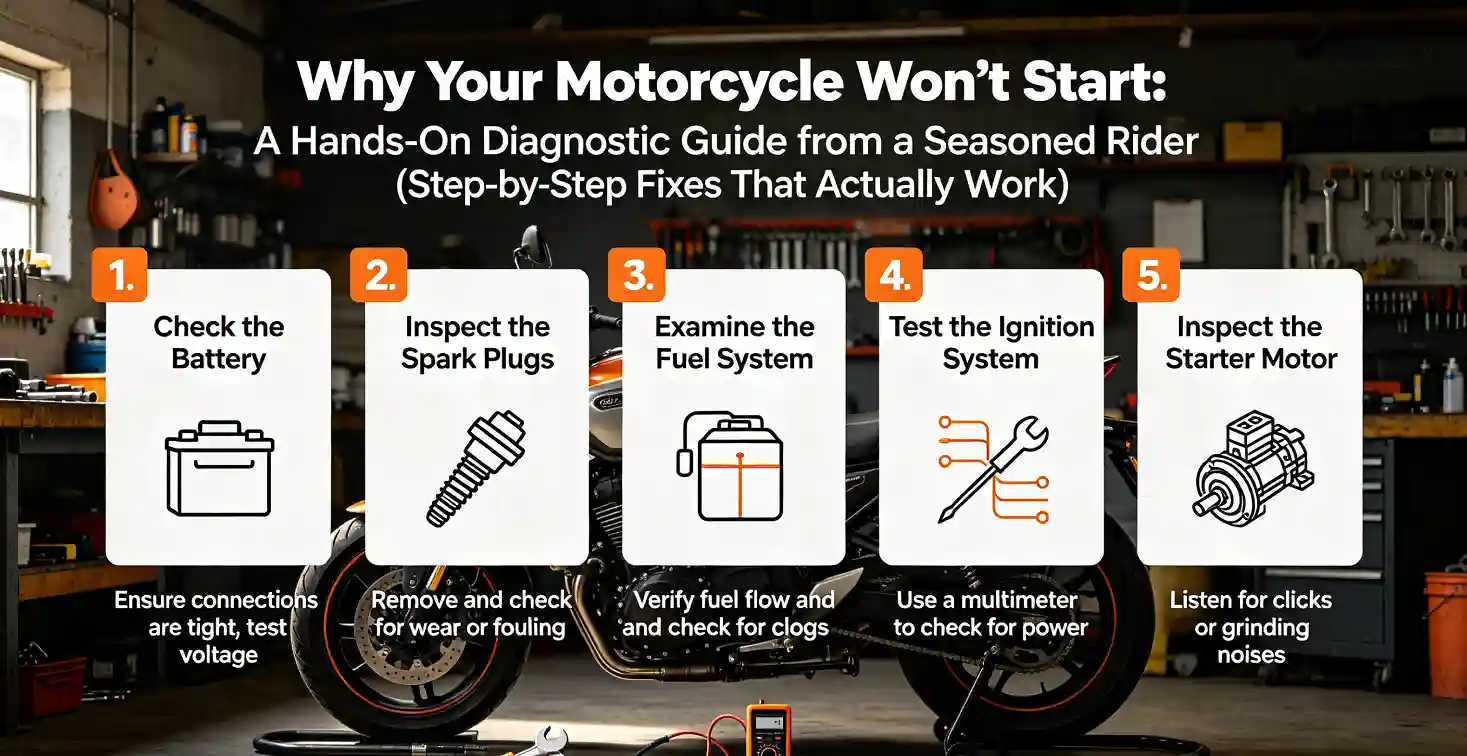
Start with the battery—not because it’s the most interesting part, but because it’s the most commonly overlooked. Even experienced riders underestimate how often batteries are the root cause. A healthy motorcycle battery should read around 12.6 to 12.8 volts when fully charged and at rest. Anything below 12.4 is already suspect. But voltage alone isn’t enough. A battery can show decent voltage and still fail under load. That’s why you need to watch what happens when you hit the starter. If the voltage drops below 10 volts during cranking, your battery is effectively done, even if it “looks fine” on paper.
Corrosion is another silent killer. Pull the seat, expose the terminals, and actually look at them. White or greenish buildup? That’s resistance, and resistance kills current flow. Clean it with a wire brush and a bit of baking soda solution, then tighten everything down properly. Loose terminals can mimic a dead battery in the most deceptive way—intermittent starts, random shutdowns, and that dreaded clicking sound.
If the battery checks out, move to the starter circuit. When you press the starter button, you should hear a distinct click from the starter relay. No click? That suggests the signal isn’t reaching the relay. This could be a faulty starter button, a blown fuse, a bad clutch switch, or even a sidestand safety switch. Modern bikes are full of these interlocks, and any one of them can prevent starting.
The clutch switch is especially notorious. It’s a tiny component, but if it fails, your bike behaves like it’s permanently in gear. Try pulling the clutch lever repeatedly while pressing the starter. If it suddenly works, you’ve found your problem. Same idea with the sidestand switch—if it’s dirty or misaligned, the bike may think the stand is down and refuse to start. Cleaning or temporarily bypassing it can confirm the diagnosis.
Now, if you do hear the relay click but the engine doesn’t crank, you’re dealing with the high-current side of the system. This is where things get more mechanical. The starter motor itself may be worn out. Brushes inside the motor wear down over time, especially on older bikes or high-mileage commuters. Sometimes, you can tap the starter lightly with a tool while pressing the button—if it suddenly spins, that’s a classic sign of worn brushes.
But don’t jump to conclusions yet. Check the starter cable—the thick wire running from the battery to the starter motor. If it’s loose, damaged, or corroded, it can’t deliver enough current. Feel it after a failed start attempt. If it’s getting warm, that’s resistance again, and resistance means inefficiency.
Let’s say the engine cranks strongly but still won’t start. Now you’re in the realm of fuel and ignition. This is where diagnosis gets more interesting, and frankly, more satisfying.
Start with fuel delivery. Turn the key and listen carefully. On fuel-injected bikes, you should hear the fuel pump prime for a few seconds. No sound? That’s your first clue. It could be a blown fuse, a faulty fuel pump relay, or a dead pump. Check the fuse box first—it’s quick and often overlooked. If the fuse is fine, you may need to test the pump directly or check for voltage at the connector.
If the pump is working, the next step is confirming fuel actually reaches the engine. On older carbureted bikes, this might mean checking fuel flow from the petcock. On modern bikes, it’s more about injectors. A quick trick is using starter fluid sparingly. Spray a small amount into the intake and try starting. If the engine briefly fires, you know the issue is fuel-related, not ignition.
Ignition problems have their own personality. If there’s no spark, the engine will crank endlessly without even trying to catch. Spark plugs are the obvious starting point. Pull them out and inspect them. Wet plugs suggest fuel is present but not igniting. Dry plugs suggest fuel isn’t reaching the combustion chamber.
Look at the condition of the plugs too. Black and sooty? That’s a rich mixture or weak spark. White and chalky? That’s lean, possibly overheating. Replace them if there’s any doubt—they’re cheap insurance.
But spark plugs are only part of the system. Ignition coils, crank position sensors, and ECU signals all play a role. Diagnosing these requires a bit more patience and sometimes a multimeter. For example, a failing crank position sensor can cause intermittent no-start conditions that are incredibly frustrating. The bike might run perfectly one day and refuse to start the next.
Ground connections are another area riders often ignore. Your entire electrical system depends on solid grounding. A loose or corroded ground wire can create symptoms that mimic multiple failures at once. Find the main ground point—usually connected to the frame—and make sure it’s clean and tight.
There’s also a category of problems that only show up under specific conditions. Heat-related failures are a classic example. A bike that starts fine cold but refuses to restart after a ride often points to electrical components failing under heat stress. Coils and sensors are common culprits here.
One of the most valuable habits you can develop is observing patterns. Does the problem happen only in the morning? Only after rain? Only when the engine is hot? These patterns are clues, and they’re often more useful than any tool.
Now let’s talk about something that separates experienced mechanics from guessers: resisting the urge to replace parts blindly. It’s tempting to throw a new battery, new plugs, new starter, and hope something fixes it. But that approach is expensive and teaches you nothing. Every step in this process should answer a question. Is there power? Is there fuel? Is there spark? If you follow that sequence, you’ll always converge on the problem.
Tools matter, but not in the way most people think. You don’t need a garage full of equipment. A decent multimeter, a basic socket set, and a bit of patience will take you surprisingly far. What you do need is a methodical mindset. Treat the bike like a system, not a mystery.
And here’s something that doesn’t get talked about enough: documentation. When you’re troubleshooting, write things down. Voltage readings, symptoms, what you tested—this turns a chaotic process into a logical one. It also prevents you from repeating the same checks over and over.
Finally, understand when to stop. There’s a point where deeper issues—like internal engine damage or complex ECU faults—require specialized tools or professional diagnostics. Knowing your limits isn’t weakness; it’s efficiency.
But most starting issues? They’re solvable in a home garage with the right approach. And when you finally hit that starter button and the engine roars back to life, there’s a kind of satisfaction you don’t get from simply riding. It’s the satisfaction of understanding your machine, of knowing that when something goes wrong, you’re not helpless—you’re prepared.
That’s what real motorcycle ownership is about. Not just riding, but knowing.