There’s a particular kind of frustration every rider knows—the moment you turn the key, hit the starter, and… nothing. Or maybe a weak crank. Or that dreaded clicking sound. A motorcycle that won’t start isn’t just an inconvenience—it’s a puzzle. And if you’ve been riding long enough, you realize that solving that puzzle is part of the experience.
I’ve been riding and wrenching on bikes for over fifteen years, from old carbureted cruisers to modern fuel-injected sport machines. And if there’s one issue that shows up more than any other, it’s a no-start condition. The good news? Most of the time, the fix is simpler than people think—you just need a logical way to approach it.
Instead of throwing parts at the problem, let’s break it down the way experienced riders and mechanics do: systematically.
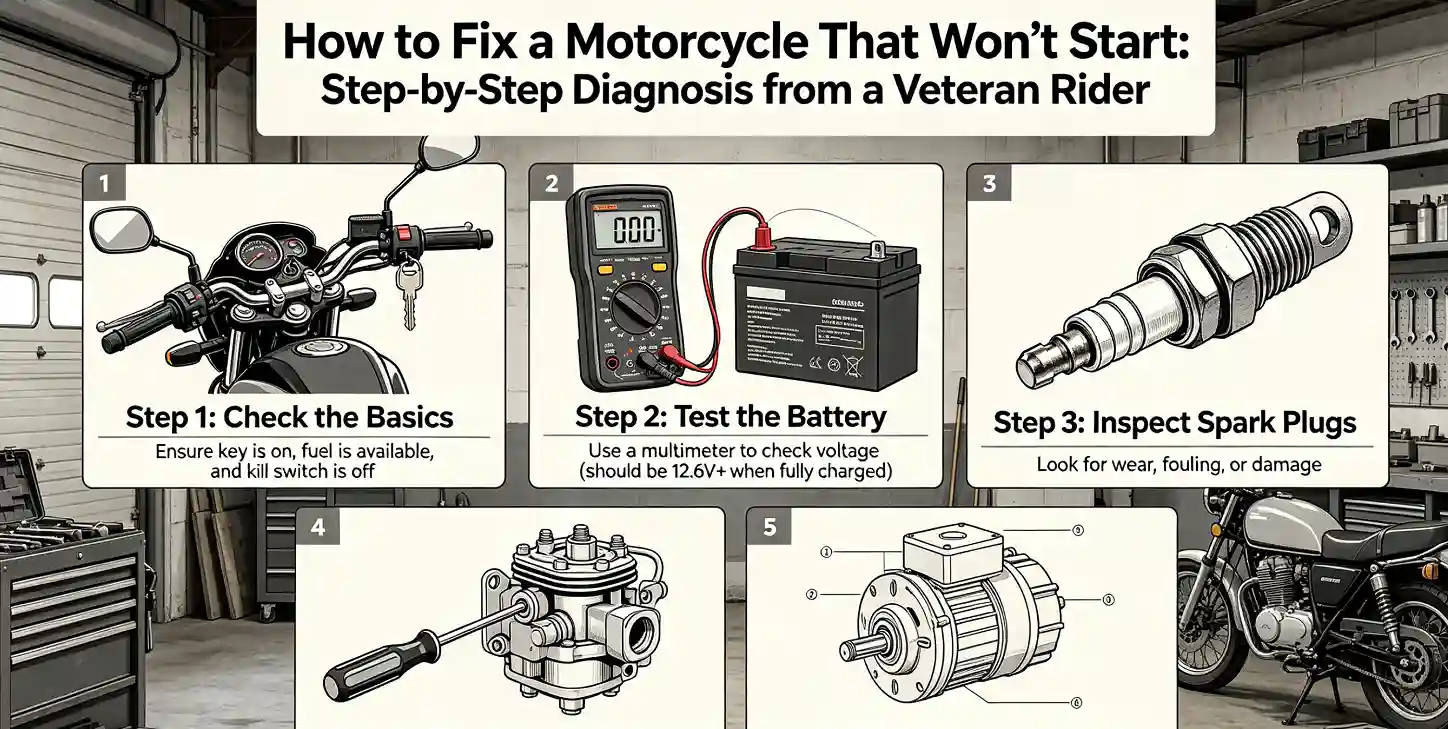
The first thing you need to understand is that every motorcycle needs three basic things to start: power, fuel, and spark. If even one of these is missing or weak, your bike won’t come to life.
Most beginners jump straight to the worst-case scenario—engine failure—but in reality, about 80% of no-start issues come down to electrical problems, especially the battery.
Start there.
When you turn the key, pay attention. Do the lights come on? Does the dash flicker? Is there a clicking sound when you hit the starter?
If the bike is completely dead—no lights, no display—you’re almost certainly dealing with a dead battery or a loose connection. Check the battery terminals first. I’ve seen bikes refuse to start just because the negative terminal was slightly loose after a long ride.
If the lights come on but dim significantly when you hit the starter, that’s another classic sign: weak battery. Even if it “kind of works,” it may not have enough amperage to crank the engine.
At this point, grab a multimeter. A healthy motorcycle battery should read around 12.6 volts when fully charged. If it’s below 12 volts, you’re already in trouble. And if it drops dramatically when you hit the starter, it’s time to either recharge or replace it.
One mistake I see a lot is riders assuming a battery is fine just because it’s relatively new. That’s not how it works. A battery can fail early due to poor charging, bad stators, or even just sitting unused for too long.
Let’s say your battery checks out, and the engine cranks normally—but still won’t start.
Now we move to fuel.
This is where experience really matters, because fuel-related issues can be subtle. Start simple: do you actually have gas in the tank? It sounds obvious, but you’d be surprised how often that’s the issue, especially with faulty fuel gauges.
If fuel level isn’t the problem, think about delivery. On fuel-injected bikes, you should hear a brief whine when you turn the key—that’s the fuel pump priming. No sound? That could mean a failed pump, blown fuse, or relay issue.
On carbureted bikes, things get a bit more mechanical. Old fuel can clog jets, especially if the bike has been sitting. Ethanol-blended gasoline is notorious for leaving deposits. If your bike sat for a few months and now won’t start, dirty carbs are a strong suspect.
A quick test: spray a small amount of starter fluid into the intake and try starting the bike. If it fires briefly and then dies, you’ve just confirmed a fuel delivery problem.
That’s your cue to clean the carburetor or inspect the fuel system.
Now let’s talk about spark—the most overlooked part of the equation.
Even with good fuel and a strong battery, your engine won’t run without a proper spark at the right time.
Remove the spark plug, reconnect it to the ignition coil, and ground it against the engine. Then crank the bike and watch for a spark. You’re looking for a strong, consistent blue spark—not a weak orange flicker.
No spark? Now you’re diving into ignition territory. This could involve the ignition coil, spark plug wires, crank position sensor, or even the ECU on newer bikes.
Before going too deep, always check the simplest thing: the spark plug itself. A fouled plug—especially from running rich or repeated failed starts—can prevent ignition entirely.
And don’t just look at it. Replace it. Spark plugs are cheap, and swapping one out is often faster than trying to “diagnose” a questionable plug.
There’s another category of issues that doesn’t get talked about enough: safety switches.
Modern motorcycles are loaded with them—side stand switch, clutch switch, neutral sensor. These are designed to prevent accidents, but they can also prevent your bike from starting if they malfunction.
If your bike only starts in neutral but not in gear with the clutch pulled, that’s a clue. If nothing happens when you hit the starter and everything else checks out, a faulty switch might be cutting the circuit.
I once spent an hour troubleshooting a bike that turned out to have a dirty side stand switch. A quick clean, and it fired right up.
Let’s not ignore the starter system itself.
If you hear a rapid clicking sound when you hit the starter, that’s usually the starter relay struggling—again pointing back to a weak battery. But if you hear a single solid click and nothing else, the starter motor itself might be the issue.
You can test this by carefully bypassing the starter relay (only if you know what you’re doing). If the starter spins, the relay is bad. If not, the motor may need servicing or replacement.
Cold weather introduces another layer of complexity.
Engines are less efficient in low temperatures, oil thickens, and batteries lose capacity. A bike that starts fine in summer may struggle in winter.
In these cases, using the choke (on carbureted bikes) or giving a slight throttle input can help. But don’t overdo it—flooding the engine will only make things worse.
If you suspect flooding, hold the throttle fully open and crank the engine. This allows more air in and can help clear excess fuel.
One thing I always tell newer riders: resist the urge to panic and start replacing random parts.
Motorcycle troubleshooting isn’t about guessing—it’s about narrowing things down logically.
Start with power. Then fuel. Then spark. Then everything else.
Write things down if you need to. Pay attention to symptoms. Every sound, every hesitation, every flicker tells you something.
There’s also a mindset shift that happens when you’ve been doing this long enough.
At some point, you stop seeing a “broken bike” and start seeing a system that just needs to be understood. That’s when working on your motorcycle becomes less of a chore and more of a skill—something almost meditative.
And the best part? The next time your bike refuses to start, you won’t feel helpless. You’ll have a process.
If you take nothing else from this, remember this:
Most no-start problems are simple. Not easy—but simple.
They just require patience, attention, and a willingness to get your hands a little dirty.
And once you fix it yourself—once that engine finally fires up after your own diagnosis—that feeling is something no shop visit can replace.