In an industry often obsessed with ever-increasing displacement, dizzying electronic rider aids, and aggressive, angular styling, a workshop in Goshen, Indiana, has quietly spent years charting a completely different course. Janus Motorcycles builds simple, beautiful, and character-rich machines that draw heavily on grit. Operating on a direct-to-consumer, built-to-order model, Janus fosters an incredibly close connection with its owners.
Regular Bike HROUY readers might recall their rugged Gryffin 450 prototype from a few years back, but the company’s underlying philosophy is best summed up by a single word: rambling. In the Janus lexicon, rambling is the art of aimless, relaxed, and exploratory riding, a mindful antidote to frantic modern lifestyles where the journey itself serves as the sole destination. There are no strict itineraries, no destination pressures, and an absolute reverence for the forgotten back roads. But when the company’s own Chief Operating Officer, Mark Zweig, decided to inject a heavy dose of vintage Grand Prix racing adrenaline into that peaceful rambling blueprint, the result was anything but aimless.
The baseline Janus Phoenix 250 was already a practice in lightweight, nostalgic design. Heavily inspired by mid-century Grand Prix racing grids, it was widely praised for its agile handling, hand-formed touches, and an aggressively narrow, long, and square fuel tank profile that harks back to a simpler era of motorsport. In factory trim, the Phoenix relied on a 229cc air-cooled, single-cylinder four-stroke engine equipped with a balance shaft for smooth operation. It produced a modest 14 horsepower at 7,000 rpm and 11.65 foot-pounds of torque at 5,500 rpm, delivered through a five-speed manual transmission and standard chain drive. Tipping the scales at a featherweight 267 pounds dry, the bike achieved upwards of 70 miles per gallon with a top speed hovering around 70 miles per hour, anchored by a 53-inch wheelbase, a 32-inch seat height, and standard disc brakes featuring a two-piston caliper up front and a single-piston setup out back.
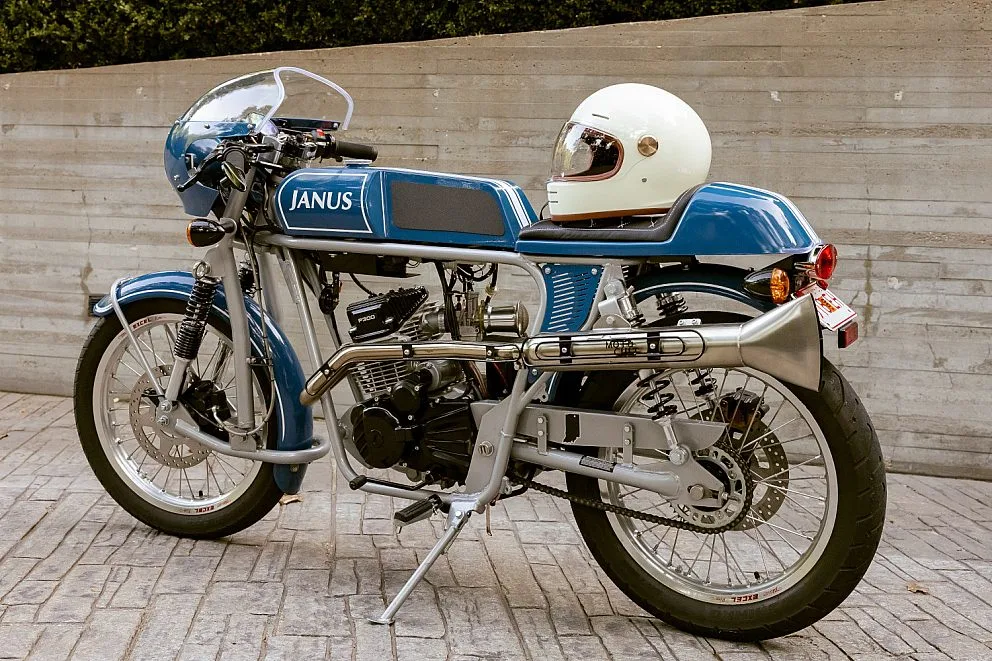
Mark Zweig noted that the Janus Phoenix 250 was already one of the lightest and narrowest cafe racers of its engine size ever created. His goal with his personal machine was to make it even more “Phoenix-like” than it was from the factory, combining more power and higher gearing with upgraded tires, suspension, a steeper front-end rake, and steering damping to handle the speeds it would now be capable of. To push the Phoenix past its gentle rambling roots, Zweig executed a total behavioral intervention beneath the fuel tank, completely discarding the factory 229cc engine. In its place, he mounted a single-cylinder Zongshen CPS 300cc silver motor. This modern powerhouse fundamentally transformed the bike’s performance envelope, instantly elevating output to a fierce 29 horsepower—more than double the factory rating.
To ensure the new motor received proper aspiration, Zweig installed a high-performance 32mm Nibbi carburetor capped off with a beautifully polished alloy velocity stack. The exhaust system received an equally purposeful upgrade, utilizing a Motocult Gryffin high-mount pipe. The high-slung pipe cleared the engine with a purposeful, routed exit, keeping the silhouette tight and the sound deliberate. The entire fueling and exhaust arrangement was then taken to Motocult for a proper dyno tune, successfully locking in a perfectly linear 29 horsepower across the revised power band.
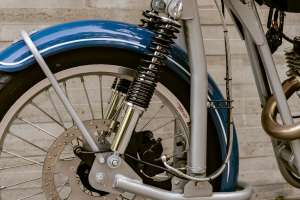
Up front, the stock forks were upgraded with softer IKON fork springs to accommodate Zweig’s body weight. At the rear, the stock dual-coil shocks were swapped out for a pair of 13.5-inch Progressive Suspension air shocks, granting the rear end highly adjustable, modern damping control. The original spoked wheels were similarly upgraded, using new-old-stock Excel 1.85-inch alloy rims wrapped in Shinko 712 tires. Acceleration and power usability were further optimized by fitting a smaller 43-tooth rear sprocket to perfectly exploit the 300cc motor’s updated power delivery, while a Motocult power rear brake kit was added to improve pedal actuation and balance front-to-back stopping power.
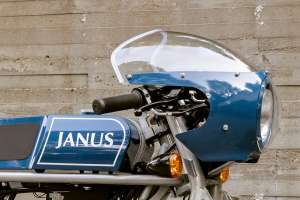
Visually, the bodywork transformed the bike from a charming country lane rambler into an urban racer. While the stock, elongated fuel tank profile naturally lent itself to the classic café racer look, the aesthetic was fully realized through a collection of carefully selected body modifications. Up front, a vintage-style café front fairing was sourced and painted to match the factory American Blue livery, instantly reconfiguring the bike’s facial profile while concealing a pair of low-slung, original Janus factory Phoenix handlebars. This flowing line was met at the rear by a Café Racer Garage cafe racer seat, featuring a diamond-stitched leather upholstery pad that transitions into a matching, color-coded rear cowl.
This project was never intended to compete with a five-figure, multi-month build from an elite global styling house like Rough Crafts or Powerbrick. Instead, it serves as a refreshing reminder that motorcycles are fundamentally meant to be fun, and it is abundantly clear that Zweig had a blast putting it together. Zweig stated that the result was everything he wanted in a motorcycle: quick, nimble, and super fun to ride. He added that the machine took him right back to the hopped-up two-stroke street bikes with expansion chambers that he used to ride long ago, capping off a spectacular exercise in lightweight, American-made performance.